ADA Parking Space Requirements in New Jersey: Complete Guide
If you own or manage a commercial property in New Jersey, ADA parking compliance is not optional — it is a federal and state legal requirement. The Americans with Disabilities Act (ADA) sets strict standards for accessible parking spaces, and New Jersey layers its own enforcement rules on top. Getting it wrong can cost you thousands of dollars in fines and legal fees, damage your reputation, and — most importantly — make your property inaccessible to people who depend on these accommodations every day.
At Sterling Pavement, we stripe and maintain parking lots across New Jersey. We see ADA violations on a daily basis — faded markings, incorrect dimensions, missing signs, and slopes that exceed the legal maximum. This guide covers everything you need to know to bring your parking lot into full ADA compliance, including the NJ-specific rules that many property owners overlook.
Why ADA Compliance Matters for NJ Property Owners
There are three compelling reasons to take ADA parking compliance seriously: financial liability, legal exposure, and basic human decency.
Financial Penalties
Under New Jersey statute N.J.S.A. 39:4-197.5, illegally parking in a handicapped space carries fines of up to $250 for a first offense. Subsequent offenses carry a minimum fine of $250 and up to 90 days of community service. But the real financial risk for property owners is not about individual parking tickets — it is about the condition of the lot itself. If your lot lacks the correct number of accessible spaces, uses the wrong dimensions, or is missing required signage, you are exposing yourself to far larger penalties.
Federal ADA Lawsuits
Under Title III of the ADA, any person with a disability can file a lawsuit against a property owner whose facility does not meet accessibility standards. These lawsuits are common and increasingly profitable for serial litigants. Settlement amounts in ADA parking cases typically range from $10,000 to $75,000, and many property owners choose to settle rather than face the cost of prolonged litigation. Attorney fees alone can exceed the settlement amount.
It Is the Right Thing to Do
Approximately 1 in 4 adults in the United States lives with a disability. Accessible parking is not a luxury — it is a necessity that allows millions of people to access businesses, medical offices, grocery stores, and public services. Properly designed and maintained accessible spaces ensure that wheelchair users, people with mobility impairments, and others who rely on accessible features can safely and independently navigate your property.
How Many Accessible Spaces Does Your Lot Need?
The 2010 ADA Standards for Accessible Design (Section 208.2) specify a minimum number of accessible parking spaces based on the total number of spaces in your lot. This table applies to all commercial properties, including retail, office, medical, restaurant, and mixed-use facilities.
| Total Spaces in Lot | Minimum Required Accessible Spaces |
|---|---|
| 1 – 25 | 1 |
| 26 – 50 | 2 |
| 51 – 75 | 3 |
| 76 – 100 | 4 |
| 101 – 150 | 5 |
| 151 – 200 | 6 |
| 201 – 300 | 7 |
| 301 – 400 | 8 |
| 401 – 500 | 9 |
| 501 – 1,000 | 2% of total |
| 1,001 and over | 20, plus 1 for each 100 over 1,000 |
Important: Of the total number of accessible spaces required, at least one in every six (or fraction of six) must be van-accessible. For example, if your lot has 200 spaces, you need 6 accessible spaces total, and at least 1 of those must be van-accessible.
Certain medical facilities have stricter requirements: rehabilitation facilities that specialize in treating conditions affecting mobility, and outpatient physical therapy facilities, must provide 20% of their total patient and visitor spaces as accessible. Hospital outpatient facilities must provide 10%. These are common oversights that we encounter in New Jersey medical office parks.
Van-Accessible Space Requirements
Van-accessible spaces are critical because wheelchair-accessible vans require significantly more room to deploy their ramps and lifts. The 2010 ADA Standards (Section 502) define two acceptable configurations:
Option 1: Wide Aisle (Preferred)
- Parking space width: 8 feet minimum
- Access aisle width: 8 feet minimum
- Total width: 16 feet
Option 2: Standard Aisle with Wide Space
- Parking space width: 11 feet minimum
- Access aisle width: 5 feet minimum
- Total width: 16 feet
Standard (non-van) accessible spaces require a minimum 8-foot-wide parking space with a 5-foot-wide access aisle.
All accessible spaces — both van and standard — must have a vertical clearance of at least 98 inches (8 feet 2 inches) along the vehicle route, at the parking space, and along the access aisle. This clearance requirement extends to any structures, signage, or overhanging trees along the path.
We frequently see lots in New Jersey where the original striping used the correct space width but an undersized access aisle. This is a violation, and it puts wheelchair users at risk. If you are unsure about your current dimensions, our line striping team can measure and correct your layout.
Signage Requirements
Proper signage is one of the most commonly violated ADA requirements in New Jersey parking lots. Both federal ADA standards and New Jersey state law impose specific signage requirements.
Federal ADA Signage Standards
- Every accessible space must have a sign displaying the International Symbol of Accessibility (ISA) — the familiar white-on-blue wheelchair icon.
- Signs must be mounted so the bottom of the sign is at least 60 inches above the ground. This ensures visibility even when a vehicle is parked in the space.
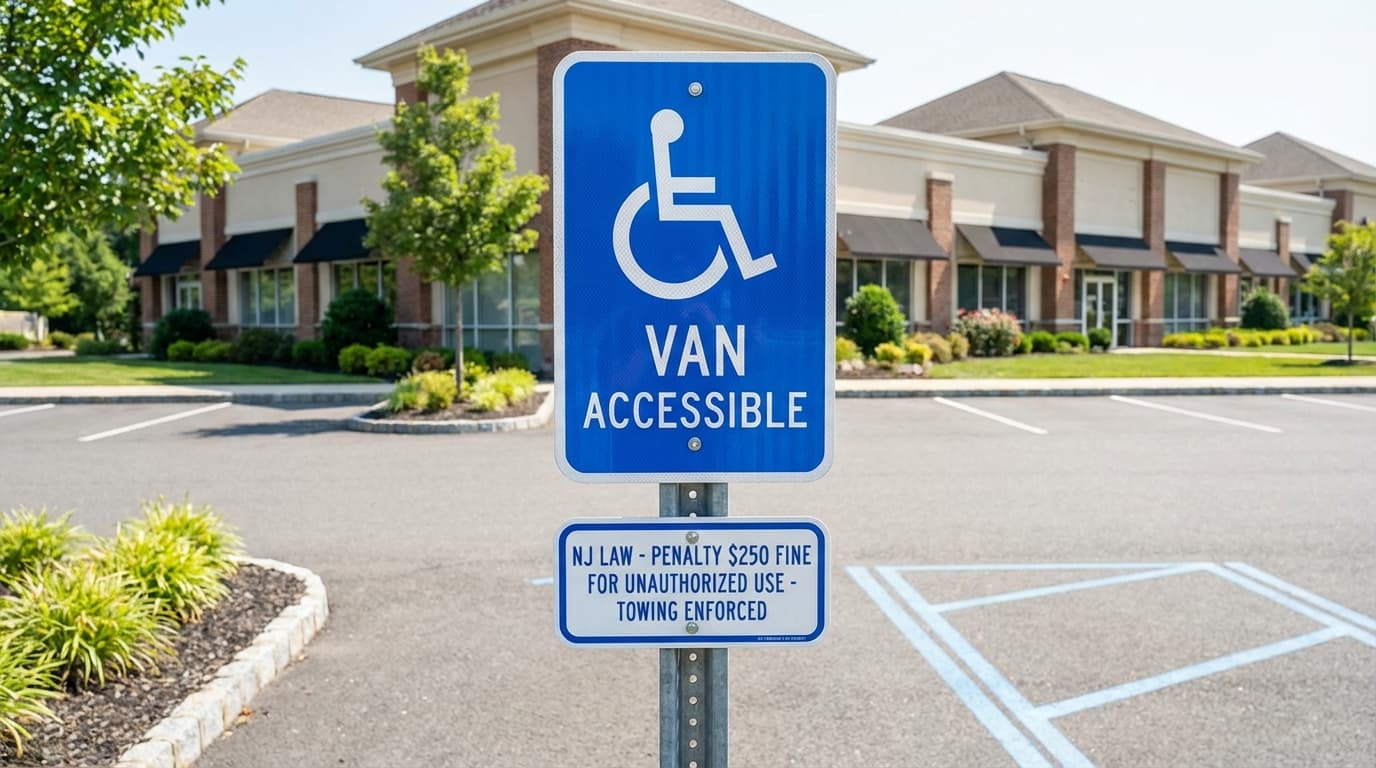
- Van-accessible spaces must include an additional "Van Accessible" designation on or below the ISA sign.
- Signs must be located at the head of each parking space (typically on a post or mounted to a wall at the front of the space).
New Jersey-Specific Signage Requirements
Under N.J.S.A. 39:4-197.5, New Jersey requires that accessible parking signs include a notice of the fine for illegal use. The sign must state that violators are subject to a fine. Many municipalities in NJ also require the specific fine amount to be displayed on the sign (typically $250). Failure to post the fine notice is itself a violation that can trigger enforcement action during a municipal inspection.
Additionally, New Jersey permits the use of pavement markings (the ISA painted on the ground) as a supplement to posted signs, but ground markings alone do not satisfy the signage requirement. You must have both a posted sign and pavement markings for full compliance.
Access Aisle Markings and Slopes
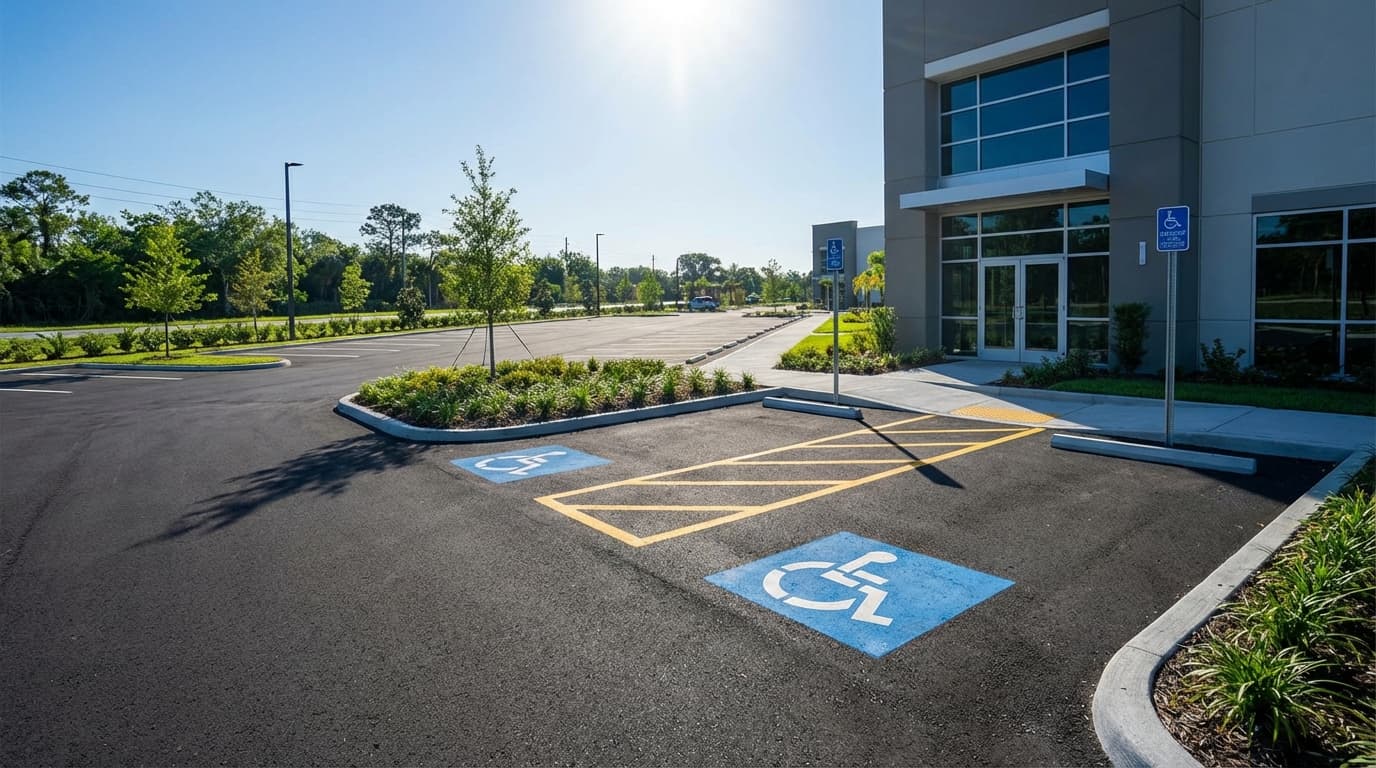
The access aisle is the striped area adjacent to each accessible parking space. It provides the room needed for wheelchair users and people with mobility devices to enter and exit their vehicles. Access aisles are not optional, and their requirements are precise.
Marking Requirements
- Access aisles must be marked with diagonal hash marks (typically blue or white paint at a 45-degree angle) to clearly indicate that the area is not a parking space.
- The words "NO PARKING" should be painted within the access aisle to deter unauthorized use.
- Aisles must run the full length of the adjacent accessible space.
- Two adjacent accessible spaces may share a single access aisle positioned between them. This is a common space-efficient layout.
Slope Requirements
Under ADA Section 502.4, accessible parking spaces and their access aisles must have a maximum slope of 2% in any direction (a ratio of 1:48). This is one of the most technically demanding requirements, because many NJ parking lots were built with drainage slopes that exceed this threshold.
A 2% slope is nearly flat — it is just enough to allow water drainage without creating a hazard for wheelchair users. If your lot has sections with steeper grades, you must position your accessible spaces in the flattest available area. In some cases, resurfacing or regrading may be necessary. Our team can evaluate your lot's slope conditions during a line striping consultation.
Accessible Route from Parking to Entrance
An accessible parking space is only useful if there is an accessible route connecting it to the building entrance. The ADA requires a continuous, unobstructed path that meets the following standards:
Curb Ramps
Where the accessible route crosses a curb, a curb ramp must be installed. Curb ramps must have a maximum slope of 1:12 (approximately 8.33%) and include flared sides with a maximum slope of 1:10. The ramp must be at least 36 inches wide, exclusive of the flared sides.
Detectable Warning Surfaces
At the transition between the pedestrian route and the vehicular way, detectable warning surfaces (truncated dome tiles) must be installed. These raised-dome surfaces alert visually impaired pedestrians that they are approaching a vehicular area. In New Jersey, these are required by both ADA and NJ DOT standards for all new construction and alterations.
Surface Requirements
- The accessible route must be firm, stable, and slip-resistant.
- The path must be at least 36 inches wide (48 inches at turns around narrow obstructions).
- The route must be free of gaps, cracks, and uneven joints that exceed 1/2 inch in width. This means maintaining your pavement surface is a compliance issue, not just a cosmetic one. If your lot has deteriorated asphalt along the accessible route, consider sealcoating or resurfacing to restore a compliant surface.
- Accessible spaces must be located on the shortest accessible route to the building entrance.
NJ-Specific Enforcement and Penalties
New Jersey has multiple enforcement mechanisms that can hold property owners accountable for ADA parking violations.
State and Local Enforcement
- NJ DOT oversees accessibility standards for state-funded projects and public right-of-way, including parking facilities associated with public buildings and transit.
- Local building inspectors and code enforcement officers review parking lot compliance during inspections for certificate of occupancy renewals, building permits, and complaint investigations.
- Municipal police enforce individual parking violations under N.J.S.A. 39:4-197.5 and can issue summonses to both illegally parked drivers and (in some cases) property owners who fail to maintain required accessible spaces.
Federal Title III Lawsuits
The most significant financial risk comes from Title III of the ADA, which applies to all places of public accommodation. Any individual with a disability — or an advocacy organization acting on their behalf — can file a federal lawsuit against a property owner for non-compliant parking.
New Jersey is an active jurisdiction for ADA serial litigation. Plaintiffs do not need to prove actual harm — only that a barrier to access exists. Courts can order injunctive relief (requiring you to fix the violation), award attorney fees to the plaintiff, and in some cases impose civil penalties under the federal statute. These maximums are adjusted annually for inflation and currently exceed $115,000 for a first violation and $230,000 for subsequent violations.
Additionally, New Jersey's Law Against Discrimination (LAD) provides a parallel state cause of action for disability discrimination that can result in compensatory and punitive damages.
Common Violations Sterling Sees in NJ Lots
After years of striping and maintaining parking lots throughout New Jersey, we have compiled a list of the most common ADA violations we encounter. If any of these sound familiar, your lot likely needs attention.
1. Faded or Illegible Markings
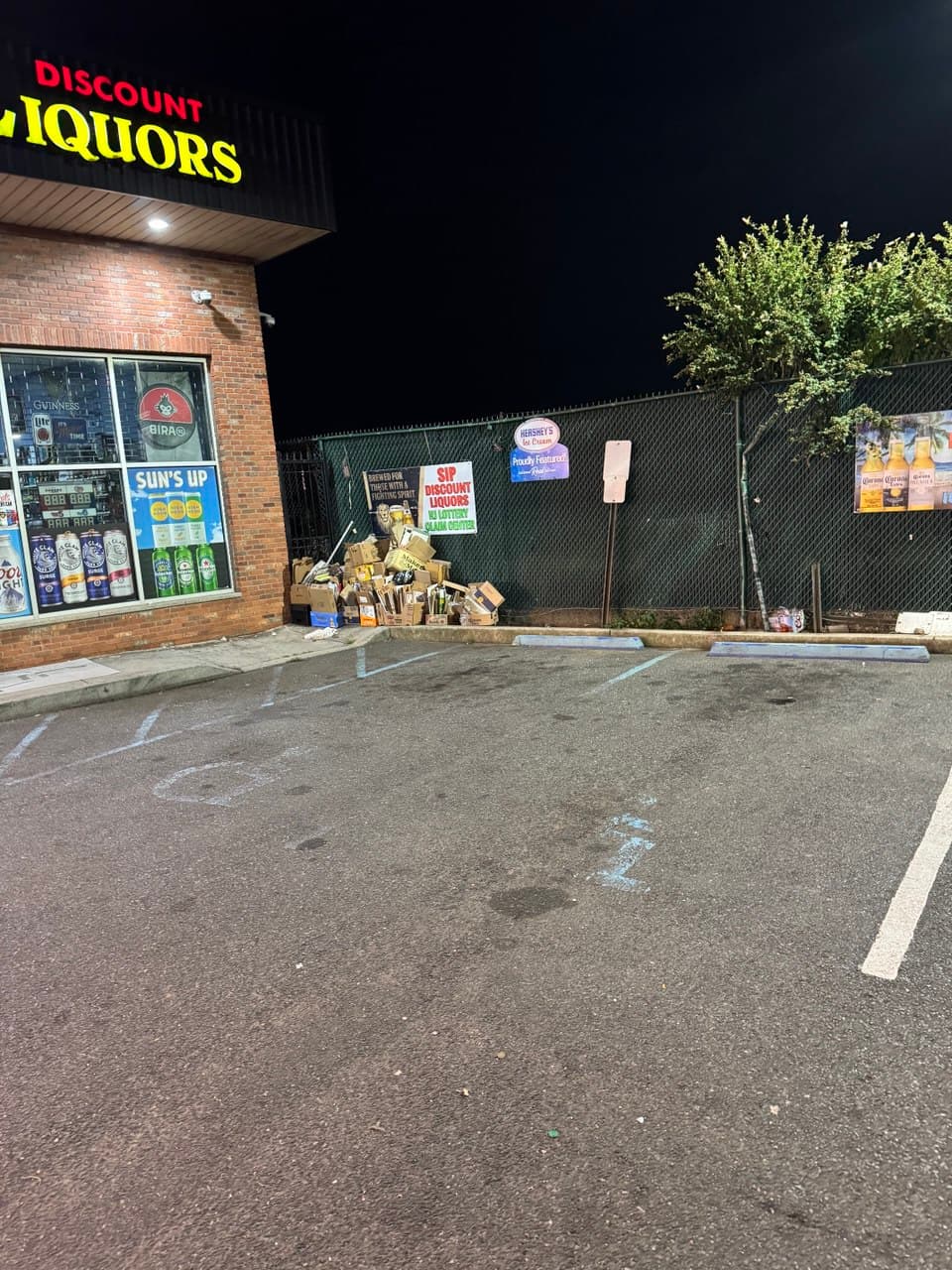
This is the single most common issue we see. Over time, New Jersey's harsh winters, road salt, snowplows, and UV exposure degrade parking lot paint. When the blue paint and ISA symbols on accessible spaces become faded to the point of being difficult to read, the space is effectively non-compliant. The ADA requires markings to be clearly visible, and faded paint does not meet that standard.
2. Incorrect Dimensions
Many older NJ lots were striped before the 2010 ADA Standards took effect, and their dimensions do not meet current requirements. We frequently find spaces that are only 7 feet wide instead of the required 8 feet, or access aisles that have been narrowed to squeeze in additional standard parking.
3. Missing or Non-Compliant Signage
Signs go missing, get damaged by weather and vehicles, or were never installed to the correct height. We commonly find signs mounted below the 60-inch minimum, signs missing the "Van Accessible" designation, and signs without the NJ-required fine notice per N.J.S.A. 39:4-197.6.
4. Excessive Slopes
Parking lots settle and shift over time. A space that was compliant when first paved may now have slopes exceeding the 2% maximum due to subsidence, root growth, or poor drainage modifications. We see this frequently in older shopping centers and office parks across central and northern New Jersey.
5. Blocked Access Aisles
Dumpsters, shopping cart corrals, landscape planters, and even parked vehicles frequently obstruct access aisles. The access aisle must remain clear at all times. Property managers should conduct regular inspections to ensure nothing is blocking these critical areas.
6. No Accessible Route
Some lots have accessible spaces that are stranded — there is no curb ramp, no marked path, or the route to the entrance is obstructed by landscaping or a change in elevation. An accessible space without an accessible route to the building is a violation.
7. Insufficient Number of Spaces
When lots are re-striped, the total space count sometimes changes, but the number of accessible spaces is not updated to match. We also see this when businesses expand their buildings and reduce their parking count without recalculating the accessible space requirement.
How Professional Striping Ensures Compliance
ADA compliance is not a one-time project. Parking lots endure constant wear from traffic, weather, and maintenance activities. Professional striping ensures your lot meets every requirement from day one and stays compliant over time.
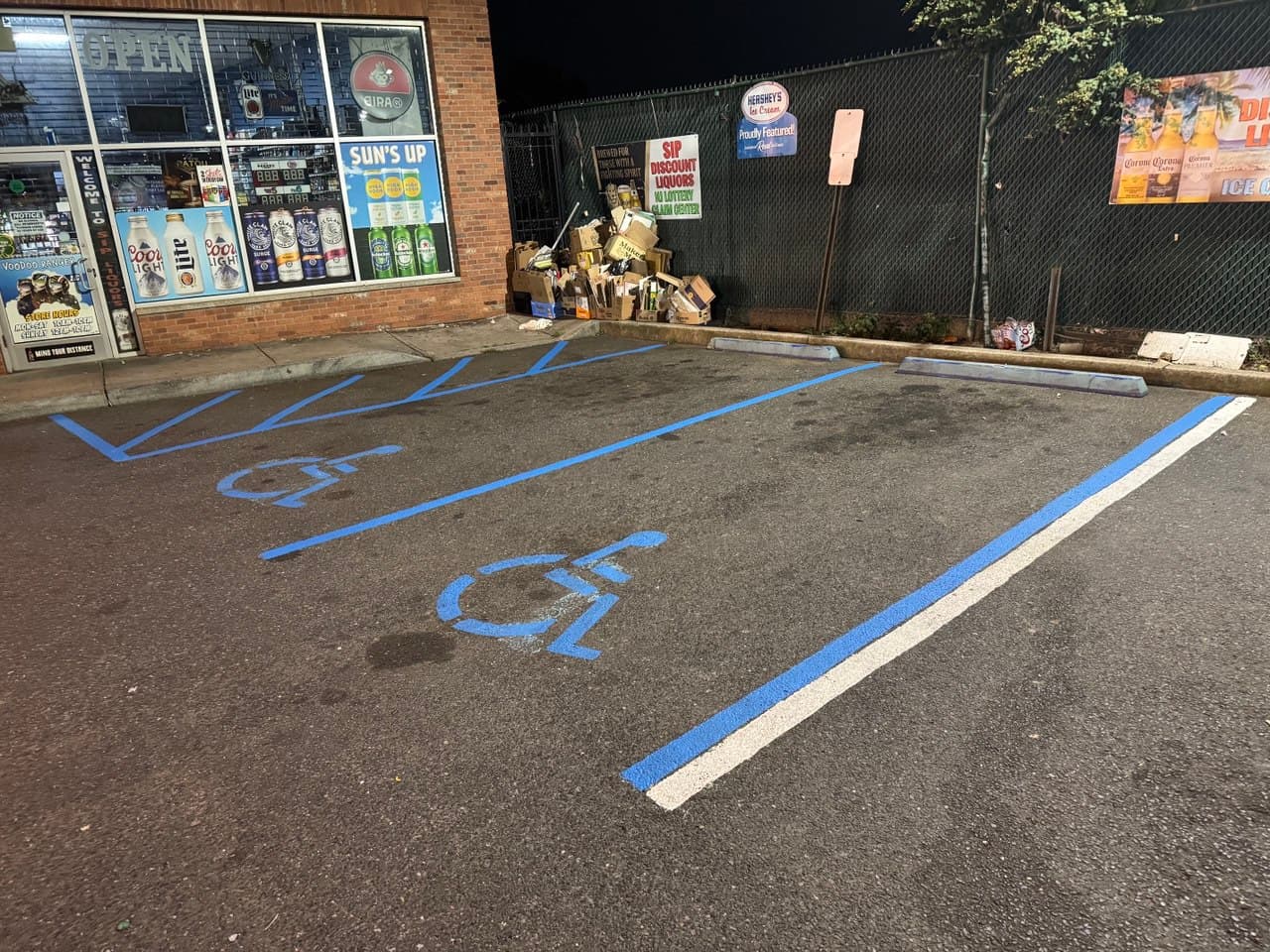
At Sterling Pavement, our line striping services include:
- Full ADA compliance audits — We measure every space, aisle, slope, and route against the 2010 ADA Standards and NJ-specific requirements before we start any striping work.
- Correct layout design — We calculate the exact number of accessible and van-accessible spaces your lot requires based on your total count, and we position them in the optimal location closest to the building entrance with compliant slopes.
- High-durability paint and materials — We use commercial-grade traffic paint that withstands New Jersey's freeze-thaw cycles, UV exposure, and heavy traffic. This keeps your markings visible and legible far longer than standard paint.
- ISA stencils and access aisle markings — We apply precise International Symbol of Accessibility stencils, diagonal hash marks, and "NO PARKING" legends using ADA-compliant colors and dimensions.
- Signage coordination — We can advise on proper sign placement and height, including the NJ-specific fine notice requirements, and coordinate with sign vendors to complete your compliance package.
- Ongoing maintenance programs — We offer scheduled re-striping to keep your markings fresh and compliant year-round. Combined with parking lot sealcoating, regular striping maintenance extends the life of your pavement and keeps your property looking professional.
Do not wait for a complaint or a lawsuit to discover that your lot is out of compliance. Contact Sterling Pavement today for a free ADA parking lot assessment. We will identify any issues, provide a clear remediation plan, and handle the striping work so you can be confident your property meets every federal and New Jersey requirement.
Need Line Striping Services?
Sterling Pavement provides professional line striping across New Jersey.